20 years of factory experience——focusing on the production and sales of all types of furniture
How to Find High-Quality Outdoor Furniture Wholesalers

Table of Contents
Finding Reliable High-Quality Outdoor Furniture Suppliers
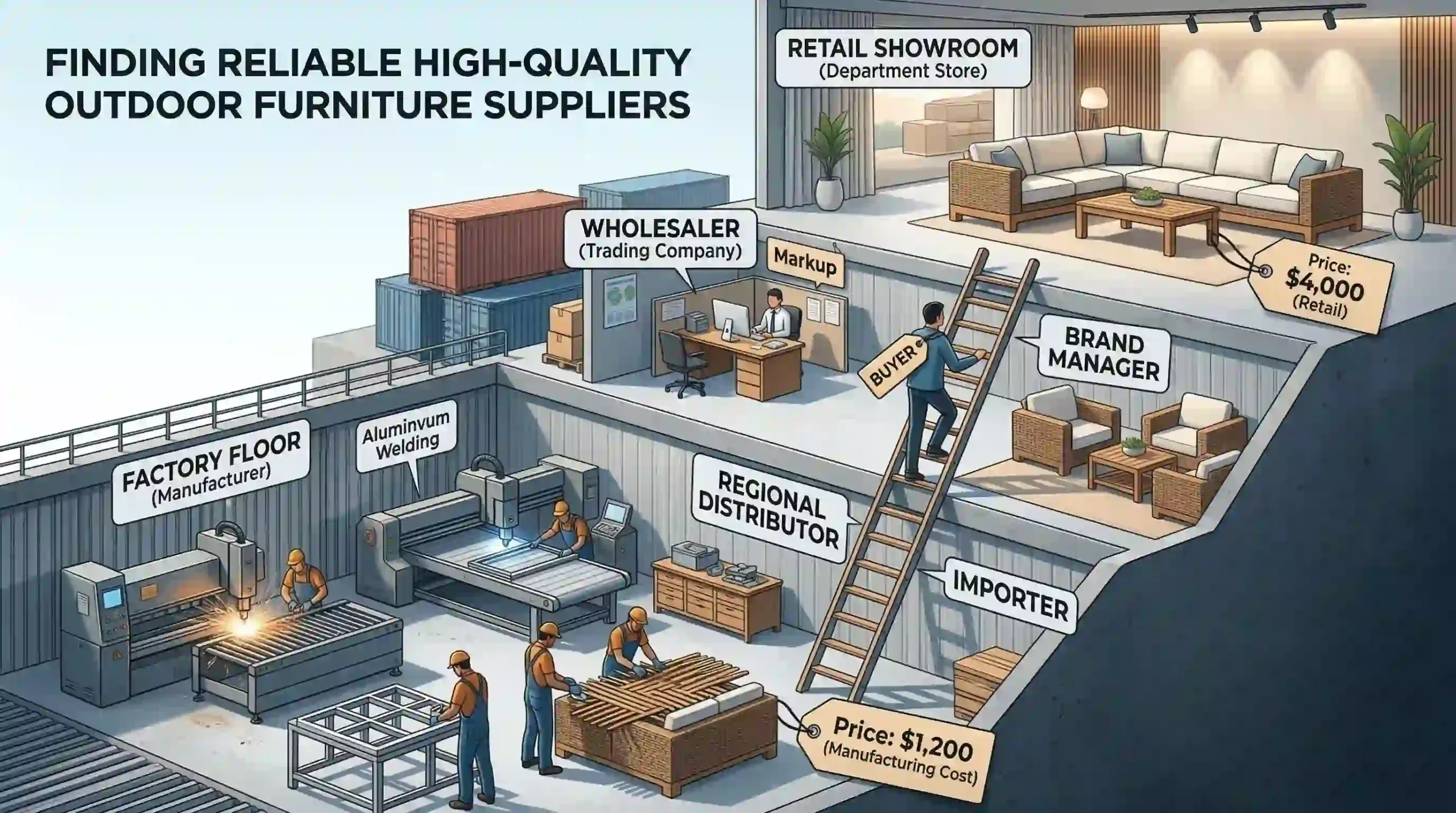
That stunning $4,000 teak sectional sitting in a high-end showroom likely left the factory floor for closer to $1,200. This massive price difference isn’t arbitrary; industry data consistently shows that traditional retail markups for outdoor furniture range from 2.5 to 4 times the manufacturing cost. By the time a patio set reaches a department store, it has passed through multiple hands—importers, regional distributors, and brand managers—each adding their own fee to the final price tag.
Finding a true partner for wholesale outdoor patio furniture allows you to bypass these expensive middle layers. Think of the furniture industry as a “Supply Chain Ladder”: the manufacturer is at the bottom creating the product, the wholesaler sits in the middle, and the retailer is at the top selling it to you. Your goal is to climb down that ladder to buy closer to the source. However, stripping away the retail safety net means you must become your own quality control inspector.
Simply paying less isn’t a victory if the wicker cracks or the frame rusts after one rainy season. Experienced buyers look for “Commercial Grade” durability—a standard designed for hotels and resorts that withstands constant use and harsh weather. While residential furniture often relies on thin materials to cut costs, commercial-quality pieces use heavier gauges and robust coatings. Securing this level of quality at factory-direct pricing requires knowing exactly what questions to ask.
Navigating this market without a map can lead to frustration, but the reward is substantial. Identifying legitimate suppliers and vetting their claims allows you to avoid common scams. The mechanics of the global market are complex, but mastering them allows you to furnish your backyard with resort-quality gear without paying the resort-level markup.
Climbing the Supply Chain Ladder: Distinguishing Manufacturers from Trading Companies
Not every supplier listing outdoor furniture wholesale prices actually owns the factory floor. Often, you are communicating with a Trading Company—a middleman who aggregates products from various sources. While they handle the logistics, they charge a “Convenience Tax” for their services, sitting between you and the absolute lowest price.
You can usually identify these entities by their product catalogs. Real manufacturers specialize because their machinery is purpose-built; a factory pressing aluminum frames rarely has the kilns to process teak wood. If patio furniture wholesalers offer a massive variety of unrelated materials, they are likely trading companies. Going direct to the factory removes the markup, but it introduces strict “Efficiency Math”—factories require high volume to justify turning on their machines.
Quick Comparison: Which Partner Fits Your Project?
- Factory: Lowest Price, High Minimum Order Quantity (MOQ), Limited product types.
- Trading Company: Medium Price, Lower MOQs, Wide variety of styles.
- Retailer: Highest Price, No minimums, Curated selection.
Choosing the right path comes down to your volume. If you need fifty chaise lounges for a hotel project, the factory’s requirements make sense. For a single backyard renovation, outdoor furniture wholesalers operating as trading companies offer the flexibility you need without the demand to buy a shipping container’s worth of goods.
Beyond the First Page of Google: Where Real Wholesale Buyers Hunt
Stop Googling “cheap patio chairs,” because that search path only leads you back to retailers. To access the true wholesale market, you need to utilize B2B (Business-to-Business) directories like Alibaba or Global Sources, but you must enter these platforms with your guard up. Always toggle the “Trade Assurance” filter—which acts like an escrow service holding your money until you confirm delivery—and strictly browse “Verified Suppliers” who have been physically inspected by third-party auditors. These filters are your primary safety nets when finding high-quality outdoor furniture wholesalers without flying overseas.
If you already have a specific aesthetic in mind, try playing detective with your browser. Take a clear photo of that expensive designer lounge chair you love and upload it directly into the search bar of a supplier directory. This strategy, known as “Reverse Image Sourcing,” often cuts through the middlemen to reveal the original factory behind the big brand. It is one of the fastest shortcuts for sourcing durable patio furniture suppliers who build the exact product you want for a fraction of the showroom price.
Professional buyers don’t just rely on scrolling; they look to industry events where companies prove their legitimacy by showing up in person. Even if you cannot travel, browsing the digital exhibitor lists of the top trade shows for outdoor decor buyers reveals the serious players who have the budget to rent booth space.
- Canton Fair (China): The massive “everything store” of global sourcing for volume buyers.
- High Point Market (USA): The style-setting hub where North American trends are defined.
- Spoga+gafa (Germany): The world’s biggest trade fair dedicated specifically to garden lifestyles.
Once you have identified a promising list of potential partners, the next step is verification.
The ‘Birth Certificate’ Test: Verifying Factory Legitimacy and Certifications
A flashy website can hide a crumbling operation. To separate real factories from middlemen, demand the product’s “birth certificate”—technical documentation proving its origin. Relying on a supplier’s word that their goods meet a weather-resistant furniture certification guide is risky because “weather-resistant” is marketing fluff. You need objective proof via independent lab reports.
The gold standard for verifying wholesale furniture manufacturers is the SGS report, a document from an agency that tests durability. When a supplier sends a PDF claiming their wicker survived extreme UV exposure, do not blindly accept it. Enter the report number into the agency’s online verification portal; if the database returns “No Record Found” or lists a different company, walk away.
Quality claims often look like alphabet soup, but understanding specific ISO codes prevents you from being dazzled by irrelevant data. ISO 9001 indicates a consistent management system, ensuring your product quality doesn’t fluctuate between orders. However, sustainable outdoor furniture manufacturing standards require ISO 14001, which specifically audits environmental impact. A factory holding both demonstrates a sophisticated operation.
Visual vetting catches scammers who Photoshop their logos onto stock images of high-end plants. Zoom in on factory photos to see if the signage aligns with the room’s perspective; if the text looks flat while the wall is angled, it is a fake. Once you confirm the factory is real, you must inspect the physical skeleton hidden beneath the weave.
What’s Under the Wicker? Sourcing Durable Metal and Wood Materials
A verified factory can still produce flimsy furniture if you don’t specify the right materials. The most critical component of aluminum outdoor furniture isn’t the stylish weave you see, but the metal “skeleton” hidden underneath. High-quality wholesalers are proud to show you the “naked frame”—uncovered structures before weaving begins—while lower-end sellers often hide thin, rust-prone steel under plastic strands.
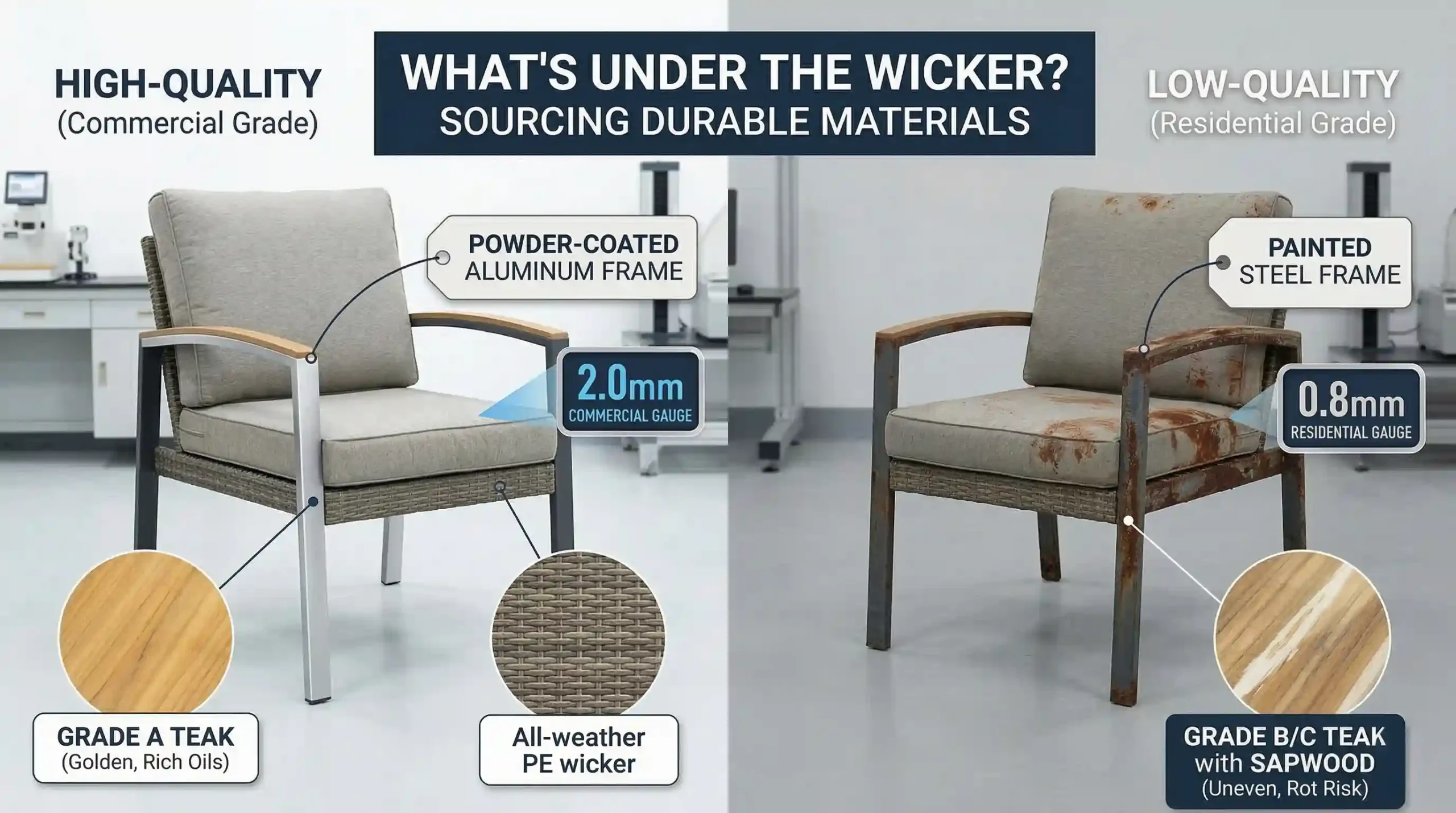
Rust is the silent killer of metal outdoor furniture, which is why you must demand powder-coated aluminum rather than painted steel. Powder coating is a dry finishing process that fuses to the metal in an oven, creating a skin far tougher and more chip-resistant than standard liquid paint. Beyond the finish, ask for the tube wall thickness; a standard retail chair might use thin 0.8mm walls, but requesting a “commercial gauge” of 1.5mm to 2.0mm ensures the frame won’t buckle under a heavy guest.
When sourcing wood patio furniture, specifically outdoor wood furniture made of teak, the “Grade A” label is non-negotiable for longevity. This timber comes from the heart of the tree, rich in natural oils that repel water and insects without chemical treatment. You can spot inferior Grade B or C teak by its uneven color and white streaks (sapwood), which will rot quickly when exposed to rain, unlike the uniform golden-honey hue of true Grade A.
To ensure your investment survives the seasons, prioritize materials based on this durability hierarchy:
- Powder-coated Aluminum: Best for rust resistance and lightweight strength.
- Grade A Teak: Best natural material for oceanside resilience.
- All-weather PE Wicker: Good, provided it covers an aluminum frame rather than steel.
- Steel: Avoid for uncovered outdoor use due to high rust risk.
Once you have identified high-quality materials, the next hurdle is convincing a factory to sell you a dozen chairs instead of a thousand, a challenge solved by understanding the “efficiency math” of Minimum Order Quantities (MOQs).
The Efficiency Math of MOQs: How to Negotiate Small Orders with Big Factories
Most shoppers recoil at minimum order requirements for bulk furniture, often set at 50 units per style. This number isn’t arbitrary; it reflects the manufacturing reality. Just as a bakery won’t heat an industrial oven to bake a single cupcake, a factory cannot cost-effectively calibrate machinery and source specific raw materials for just one chair. To a manufacturer, a tiny production run costs nearly as much to organize as a large one, making low quantities financial losses unless the pricing structure changes.
You can often bypass these barriers by negotiating pricing with furniture vendors using the “trial order” strategy. Instead of walking away, ask if the supplier accepts a “sample surcharge” to produce a smaller batch. Manufacturers often agree to produce ten chairs instead of fifty if you pay a 20-30% premium to cover their setup inconvenience. This tactic allows you to secure inventory without filling a garage, trading a slightly higher unit cost for significantly lower upfront risk.
Securing wholesale outdoor patio furniture without buying hundreds of identical items is also possible through “mixed container” terms. While a factory might require a high total volume, they may allow you to split that number across different products, like combining dining sets and loungers to hit their revenue targets. Once you have negotiated these quantities, you must verify the product’s reality by ordering a single physical prototype.
The Sample Request Process: Testing Quality Before You Buy Bulk
Once pricing is set, requesting a physical item is vital, but beware of the “Golden Sample.” This industry term refers to a flawless prototype created specifically to impress buyers, often hand-finished to a higher standard than the actual mass-produced items. To ensure you aren’t misled, explicitly request a “random production sample” pulled from an existing line to verify the true manufacturing quality of your outdoor sectional sofa.
Treating this prototype gently is a mistake; you need to adopt a “destructive testing” mindset to ensure longevity. Perform a DIY “Salt Spray Test” by spraying metal joints with heavy saltwater and leaving them outside to check for rust, mimicking years of coastal wear. For cushions, verify the “Double Rub Count”—a standard metric for how many swipes fabric endures before wearing—by vigorously scrubbing the material with coarse paper to see if the weave snaps.
Mastering the sample request process for wholesale buyers means running your prototype through a physical checklist before approving the order:
- Salt spray test: Check for rapid corrosion on metal frames.
- Weight capacity test: Overload the seat to check for frame bending.
- UV exposure check: Leave fabric in direct sun to watch for fading.
- Joint weld inspection: Ensure welds are smooth, not bumpy.
- Fabric rub-count: Verify abrasion resistance with a scratch test.
With sourcing durable patio furniture suppliers complete, you must now move the goods, which requires decoding complex shipping terms like FOB.
FOB and Freight: Navigating the Logistics of Overseas Shipping
Securing a unit price is only half the battle; getting bulky items from a foreign dock to your backyard requires navigating the complex logistics of importing patio furniture overseas. Most patio furniture wholesalers quote prices as “FOB” (Free On Board). This functions like buying a sofa where the store loads it onto the truck, but you are responsible for the drive home. Under these terms, the seller pays to get the goods to their local port, but you cover the ocean freight and delivery to your final address.
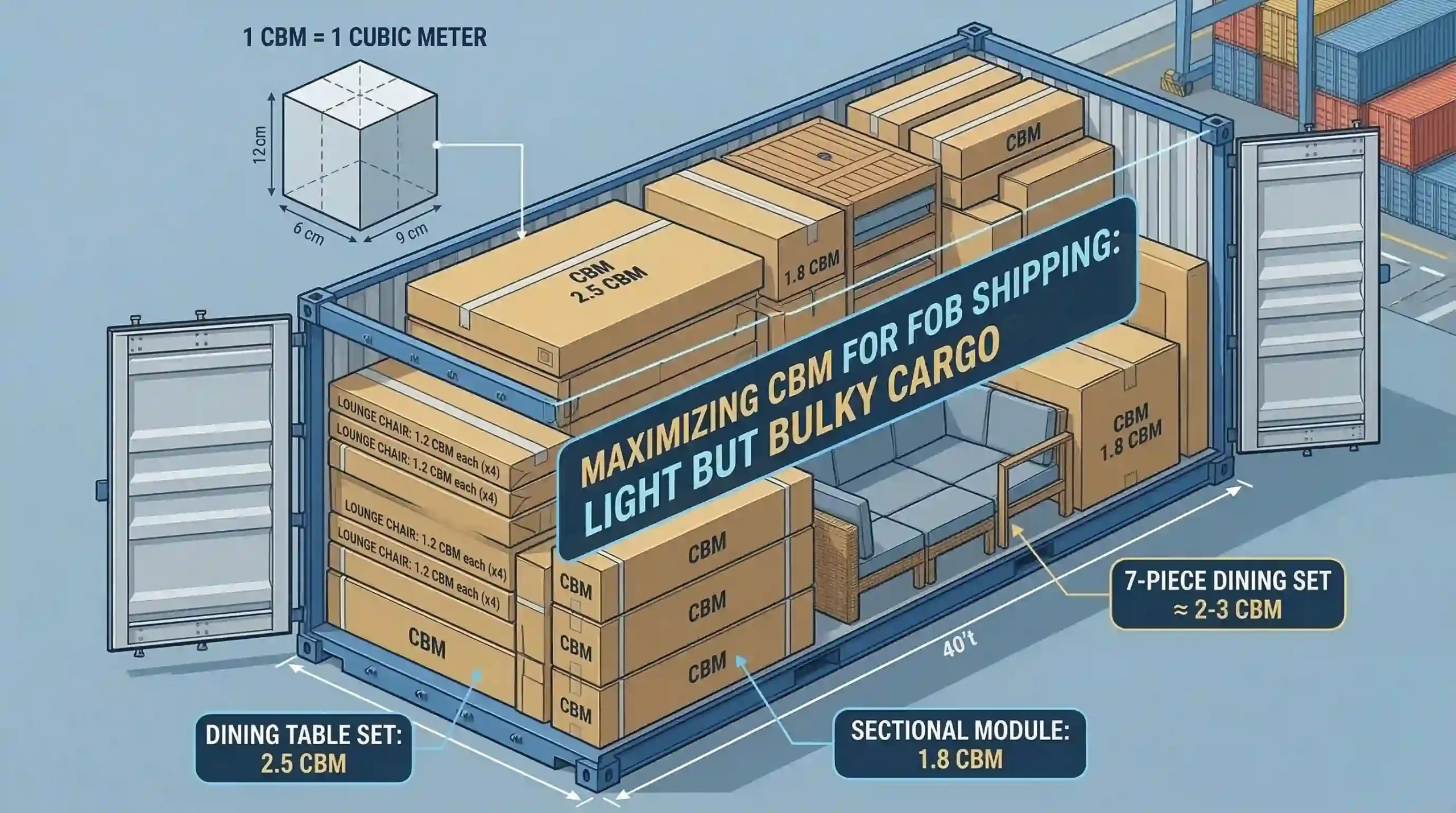
Cost calculation depends on volume, measured in CBM (Cubic Meters), rather than weight. Since wholesale outdoor patio furniture is notoriously light but bulky—imagine shipping a box of air—you must maximize container space. A standard 7-piece dining set typically occupies roughly 2 to 3 CBM, so asking your supplier for the total CBM allows you to estimate shipping rates before you commit.
Unless you know tariff codes, hiring a Customs Broker is essential to clear goods through legal hurdles. For a simpler experience, ask for “DDP” (Delivered Duty Paid), an all-inclusive price where the seller handles every step to your door, eliminating surprise fees. With logistics settled, focus on protecting your investment against the industry’s darker side.
Red Flags and Scams: Avoiding the ‘Ghosting Vendor’ and ‘Quality Fade’
Identifying red flags when choosing patio furniture distributors protects your wallet from the “Ghosting Vendor” who disappears after payment. Legitimate wholesale furniture manufacturers leave a digital paper trail, whereas scammers often display specific warning signs. Watch for these four critical indicators: requesting Western Union payments instead of bank transfers, a lack of recent ‘Transaction Level’ history on major platforms, refusing third-party inspections, and using inconsistent free email domains rather than company addresses.
Even authentic factories may attempt “Quality Fade,” a tactic where they swap high-quality materials for cheaper alternatives after you approve the initial sample. Since evaluating factory production capacity for outdoor sets remotely is difficult, prevent this by hiring a Third-Party Inspection service. For a small fee, an independent agent visits the factory floor before the goods leave, ensuring the premium aluminum you paid for hasn’t been replaced with rust-prone steel.
Finalize your protection by using “Escrow” or Trade Assurance payment methods. These systems hold your funds in a neutral account, releasing payment to the seller only after the shipping documents prove the cargo has actually departed. With these safeguards in place, you are ready to execute your sourcing strategy.
Your 30-Day Sourcing Action Plan: From Search to Sofa
You no longer need to let showroom markups dictate your patio’s potential. By prioritizing Total Cost of Ownership—where a durable frame outlasts a cheap bargain over five years—you ensure your savings are real. To go from browsing to buying, follow this sourcing roadmap:
- Week 1 (The Search): Filter directories and verify business licenses.
- Week 2 (The Vetting): Contact three suppliers to gauge communication speed.
- Week 3 (The Sample): Order a unit or request detailed “naked frame” photos.
- Week 4 (The Order): Finalize material specs and arrange shipping.
Whether you are outfitting a personal oasis or handling seasonal inventory planning for furniture retailers, the principle remains: true value endures. You now possess the roadmap to find high-quality outdoor furniture wholesalers that deliver durability rather than just low prices. Send your first inquiry today and secure furniture that survives the seasons.